Medicare Billing Guidelines Explained (2026): The Complete Guide for Medical Coders and Healthcare Providers
Welcome To Medico Pediaa :- Healthcare billing in the United States is one of the most complex aspects of the healthcare system, and Medicare billing guidelines play a major role in ensuring providers receive accurate reimbursement for covered medical services. Whether you’re a medical coder, medical biller, healthcare provider, CPC student, or practice administrator, understanding Medicare billing rules is essential for reducing claim denials, maintaining compliance, and ensuring proper reimbursement.
Medicare is the largest government-funded health insurance program in the United States, serving millions of eligible individuals every year. Because of its size and regulatory requirements, healthcare professionals must carefully follow Medicare billing guidelines when submitting claims.
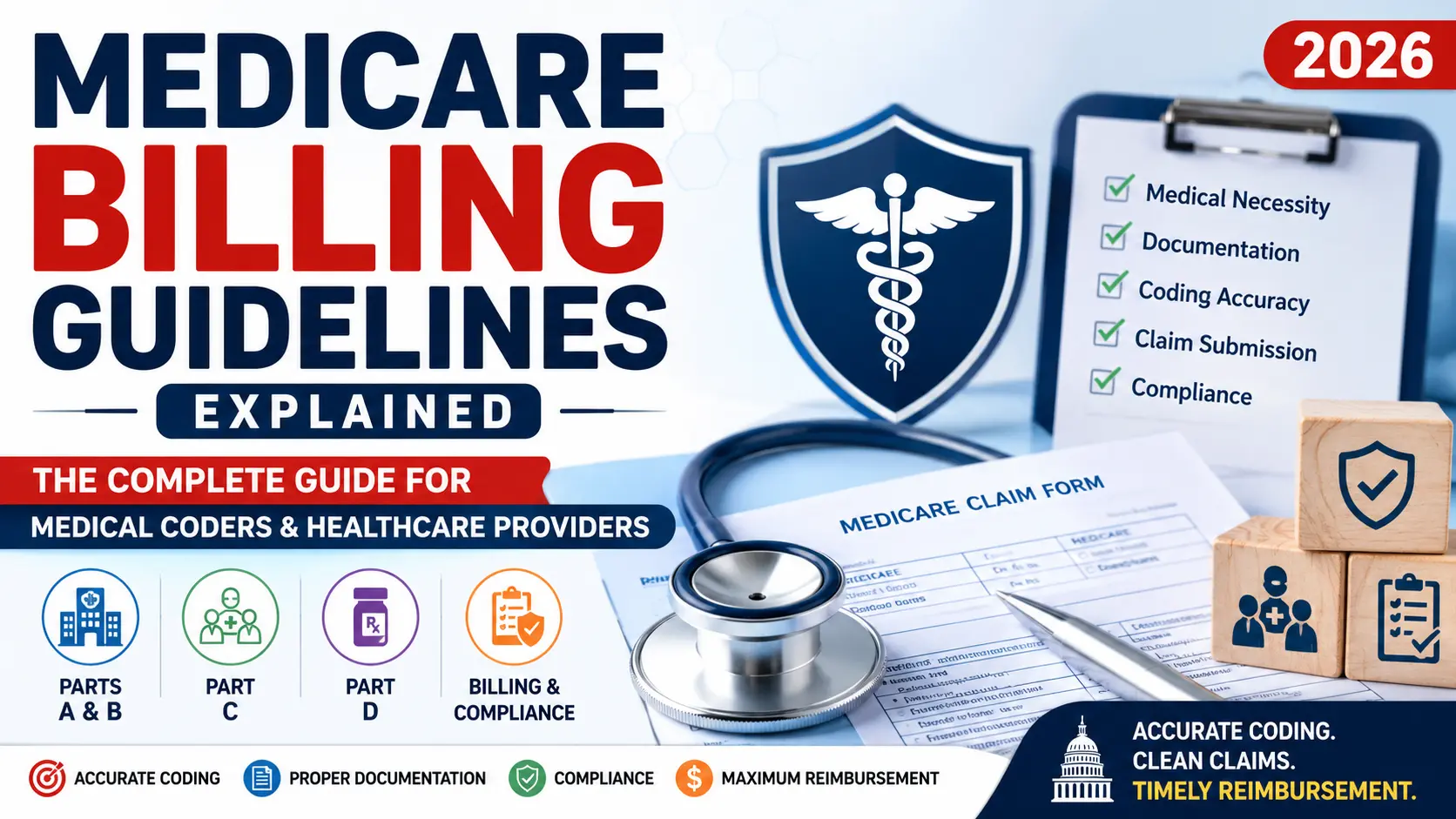
This comprehensive guide explains Medicare billing in simple language, including Medicare Parts A, B, C, and D, documentation requirements, medical necessity, claim submission, common billing mistakes, and best practices for medical coders.
What Is Medicare?
Medicare is a federal health insurance program administered by the Centers for Medicare & Medicaid Services (CMS). It primarily provides healthcare coverage for:
- Individuals aged 65 years or older
- Certain younger individuals with qualifying disabilities
- People with End-Stage Renal Disease (ESRD)
- Individuals with Amyotrophic Lateral Sclerosis (ALS)
Unlike private insurance, Medicare follows standardized national billing and reimbursement policies. Healthcare providers must comply with CMS guidelines when reporting diagnoses, procedures, and medical services.
Why Are Medicare Billing Guidelines Important?
Following Medicare billing guidelines helps healthcare organizations:
- Receive accurate reimbursement
- Reduce claim denials
- Avoid billing errors
- Maintain compliance with CMS regulations
- Improve documentation quality
- Prevent fraud and abuse
- Pass audits successfully
Failure to follow Medicare billing rules can result in denied claims, delayed payments, overpayments, penalties, or compliance investigations.
Understanding Medicare Parts
Medicare Part A
Medicare Part A primarily covers hospital-based services, including:
- Inpatient hospital stays
- Skilled nursing facility care
- Hospice services
- Limited home healthcare
Medical coders working in inpatient settings frequently use ICD-10-CM and ICD-10-PCS codes for Medicare Part A claims.
Medicare Part B
Part B covers outpatient medical services, including:
- Physician office visits
- Preventive care
- Diagnostic testing
- Laboratory services
- Emergency department visits
- Durable Medical Equipment (DME)
- Physical therapy
- Imaging services
Professional coders generally assign:
- CPT Codes
- HCPCS Level II Codes
- ICD-10-CM Diagnosis Codes
for Medicare Part B billing.
Medicare Part C (Medicare Advantage)
Medicare Advantage plans are offered by private insurance companies approved by CMS.
These plans generally combine:
- Hospital coverage
- Medical coverage
- Additional benefits such as dental, vision, hearing, wellness programs, and sometimes prescription drug coverage.
Although administered by private insurers, providers must still follow Medicare regulations and payer-specific billing requirements.
Medicare Part D
Part D provides prescription drug coverage.
It helps beneficiaries pay for:
- Prescription medications
- Brand-name drugs
- Generic medications
- Certain vaccines
Pharmacies and prescription benefit managers follow Part D billing guidelines for medication claims.
What Is Medicare Billing?
Medicare billing is the process of submitting healthcare claims to Medicare for reimbursement after healthcare services are provided.
A typical billing process includes:
- Patient registration
- Insurance verification
- Medical documentation
- Medical coding
- Charge entry
- Claim creation
- Electronic claim submission
- Claim adjudication
- Payment posting
- Appeals (if necessary)
Each step must be completed accurately to reduce billing errors.
Medical Necessity
One of Medicare’s most important billing principles is Medical Necessity.
Simply performing a procedure does not guarantee payment.
Healthcare providers must demonstrate that:
- The service was reasonable.
- The service was medically necessary.
- The diagnosis supports the procedure.
- Documentation justifies treatment.
If medical necessity is not supported by documentation, Medicare may deny payment even if the procedure was performed correctly.
Medical coders should always ensure diagnosis codes appropriately support billed services.
Documentation Requirements
Good documentation forms the foundation of successful Medicare billing.
Medical records should clearly include:
- Chief complaint
- History of present illness
- Physical examination
- Assessment
- Diagnosis
- Treatment plan
- Physician signature
- Date of service
- Procedure details
Incomplete documentation is one of the most common reasons for Medicare claim denials.
Remember:
If it isn’t documented, it wasn’t done.
This principle is widely recognized in medical coding and compliance.
Role of Medical Coders
Medical coders play a critical role in Medicare billing.
Their responsibilities include:
- Reviewing physician documentation
- Assigning ICD-10-CM diagnosis codes
- Assigning CPT procedure codes
- Selecting HCPCS codes
- Applying modifiers correctly
- Ensuring coding compliance
- Supporting claim accuracy
Accurate coding improves reimbursement while reducing audit risk.
Medicare Billing Workflow
A simplified Medicare billing workflow looks like this:
Patient Visit → Clinical Documentation → Medical Coding → Charge Entry → Claim Submission → Medicare Processing → Payment or Denial
Every stage depends on accurate information from the previous step.
Medicare Claim Submission
Most providers submit Medicare claims electronically using the HIPAA standard claim formats.
The basic claim process includes:
- Patient eligibility verification
- Documentation review
- Code assignment
- Claim validation
- Electronic submission
- Medicare processing
- Explanation of Benefits (EOB) or Remittance Advice
- Payment or denial
If a claim is rejected or denied, providers may need to correct errors and resubmit or file an appeal when appropriate.
ICD-10-CM, CPT, and HCPCS in Medicare Billing
Medicare billing relies on standardized coding systems.
ICD-10-CM
Used to report diagnoses and medical conditions.
Example:
- E11.9 – Type 2 Diabetes Mellitus without complications
CPT Codes
Used to report physician services and medical procedures.
Example:
- 99213 – Established patient office visit
HCPCS Level II Codes
Used for:
- Medical supplies
- Ambulance services
- Durable Medical Equipment (DME)
- Drugs administered in outpatient settings
Correct code selection is essential because reimbursement depends on accurate coding.
National Correct Coding Initiative (NCCI)
CMS developed the National Correct Coding Initiative (NCCI) to prevent improper billing.
NCCI helps identify:
- Incorrect code combinations
- Duplicate billing
- Unbundling
- Mutually exclusive procedures
Medical coders should review NCCI edits before submitting claims to avoid unnecessary denials.
Medicare Modifiers List
Modifiers provide additional information about a medical service without changing the definition of the CPT or HCPCS code. Medicare uses modifiers to understand the circumstances under which a service was performed.
Some commonly used Medicare modifiers include:
Modifier 25
Used when a physician performs a significant, separately identifiable Evaluation and Management (E/M) service on the same day as another procedure.
Modifier 59
Indicates that a procedure or service was distinct and independent from other services performed on the same day.
Modifier 24
Used when an unrelated E/M service is provided during a postoperative global period.
Modifier 57
Applied when an E/M service results in the initial decision to perform major surgery.
Modifier 26
Represents the professional component of a diagnostic service.
Modifier TC
Represents the technical component of a diagnostic service.
Using the correct modifier is essential because incorrect modifier usage may result in claim denials or payment delays.
Evaluation and Management (E/M) Billing Guidelines
Evaluation and Management (E/M) services are among the most frequently billed services under Medicare Part B.
Proper E/M coding depends on:
- Medical Decision Making (MDM)
- Total physician time (when applicable)
- Accurate documentation
- Patient status (new or established)
- Place of service
Medical coders should ensure that documentation supports the selected E/M code. Overcoding and undercoding should always be avoided.
Place of Service (POS) Codes
The Place of Service code identifies where healthcare services were provided.
Common POS codes include:
- 11 – Office
- 19 – Off Campus Outpatient Hospital
- 22 – On Campus Outpatient Hospital
- 21 – Inpatient Hospital
- 23 – Emergency Room
- 31 – Skilled Nursing Facility
- 32 – Nursing Facility
- 02 – Telehealth
- 10 – Telehealth (Patient’s Home)
Selecting the correct POS code helps ensure accurate reimbursement.
Common Medicare Billing Errors
Even experienced healthcare organizations make billing mistakes.
The most common Medicare billing errors include:
- Incorrect diagnosis coding
- Wrong CPT or HCPCS codes
- Missing modifiers
- Incomplete documentation
- Duplicate claim submission
- Billing non-covered services
- Incorrect patient information
- Invalid National Provider Identifier (NPI)
- Failure to verify Medicare eligibility
- Missing medical necessity documentation
Regular internal audits can help identify and correct these issues before claims are submitted.
Medicare Compliance Tips
Compliance is essential for every healthcare organization.
Follow these best practices:
- Verify patient eligibility before services are provided.
- Keep documentation complete and accurate.
- Stay updated with CMS billing and coding changes.
- Use current ICD-10-CM, CPT, and HCPCS code sets.
- Review National Correct Coding Initiative (NCCI) edits.
- Perform regular coding audits.
- Educate coding and billing staff.
- Maintain proper documentation for every billed service.
- Submit claims promptly.
- Protect patient health information according to applicable privacy regulations.
Strong compliance practices reduce financial risk and improve claim acceptance rates.
Medicare vs Medicaid
Although Medicare and Medicaid are often confused, they are different healthcare programs.
| Medicare | Medicaid |
|---|---|
| Federal health insurance program | Joint federal and state assistance program |
| Primarily for people aged 65+ and certain younger individuals with qualifying disabilities | Based mainly on income and eligibility requirements |
| Managed by CMS | Administered by individual states within federal guidelines |
| Standardized nationwide rules | Rules and benefits vary by state |
Understanding these differences helps coders and billers follow the correct payer requirements.
Best Practices for Medical Coders
Professional medical coders can improve billing accuracy by following these recommendations:
- Read the complete provider documentation before assigning codes.
- Never code from assumptions.
- Verify diagnosis-to-procedure relationships.
- Use the latest coding manuals and official guidance.
- Stay informed about annual coding updates.
- Participate in continuing education.
- Review payer-specific billing policies when necessary.
- Ask providers for clarification whenever documentation is unclear.
Accurate coding contributes to proper reimbursement and high-quality healthcare data.
Future of Medicare Billing
Healthcare billing continues to evolve with advances in technology and regulatory updates.
Emerging trends include:
- Artificial Intelligence (AI) in coding
- Automated claim validation
- Predictive denial management
- Clinical documentation improvement (CDI)
- Electronic prior authorization
- Value-based healthcare reimbursement
- Data analytics for revenue cycle management
Medical coders who continuously update their knowledge and technical skills will remain highly valuable in the healthcare industry.
Frequently Asked Questions (FAQs)
1. What are Medicare Billing Guidelines?
Medicare Billing Guidelines are official rules that help healthcare providers and medical coders correctly submit claims for services covered under Medicare.
2. Who must follow Medicare billing rules?
Hospitals, physicians, clinics, medical coders, billers, and other healthcare providers submitting Medicare claims should follow applicable Medicare billing requirements.
3. What is medical necessity in Medicare?
Medical necessity means that a healthcare service must be reasonable, necessary, and supported by appropriate clinical documentation for the patient’s condition.
4. Which coding systems are used for Medicare billing?
Medicare billing commonly uses ICD-10-CM for diagnoses, CPT for physician procedures, and HCPCS Level II for supplies, equipment, and certain services.
5. What is the role of NCCI edits?
NCCI edits help prevent incorrect coding combinations, duplicate billing, and unbundling of services.
Conclusion
Understanding Medicare Billing Guidelines is essential for accurate medical coding, efficient claim submission, and regulatory compliance. Whether you are a medical coder, biller, healthcare provider, or CPC student, following Medicare documentation requirements, coding standards, modifier rules, and claim submission processes can significantly reduce claim denials and improve reimbursement accuracy.
Because Medicare policies evolve over time, professionals should regularly review official CMS updates and continue developing their coding knowledge. Combining accurate documentation with correct ICD-10-CM, CPT, and HCPCS coding helps healthcare organizations maintain compliance while supporting high-quality patient care.
References
- Centers for Medicare & Medicaid Services (CMS). Medicare Learning Network (MLN) – https://www.cms.gov
- Medicare.gov – Official U.S. Medicare Information – https://www.medicare.gov
- American Medical Association (AMA) – CPT® Resources – https://www.ama-assn.org
Share this article For More Information.
If you have any questions, please contact us.
Medicare Billing Guidelines Explained (2026): The Complete Guide for Medical Coders
Thanks For Reading this Article.
Healthcare Data Analyst Salary in India & USA Complete Guide 2026-27 : https://medicopediaa.com/category/health-news/
For Any Query : DM me on Insta : – @medico_pediaa