ICD-10-CM FY 2027 Updates Explained: 190 New Codes, 30 Deleted Codes, and 4 Revised Codes
Introduction
Welcome To Medico Pediaa : The ICD-10-CM FY 2027 update introduces important changes that every medical coder, healthcare provider, medical biller, and CPC exam candidate should understand. Each fiscal year, the Centers for Medicare & Medicaid Services (CMS) and the National Center for Health Statistics (NCHS) update the ICD-10-CM code set to reflect advances in medicine, improve clinical documentation, and support more accurate reporting.
For Fiscal Year (FY) 2027, the official update includes:
- 190 New ICD-10-CM Codes
- 30 Deleted Codes
- 4 Revised Code Descriptions
These changes become effective on the official implementation date announced by CMS and should be incorporated into coding practices for claims submitted on or after the effective date.
In this article, we’ll review the most significant FY 2027 changes and explain what they mean for medical coding professionals.
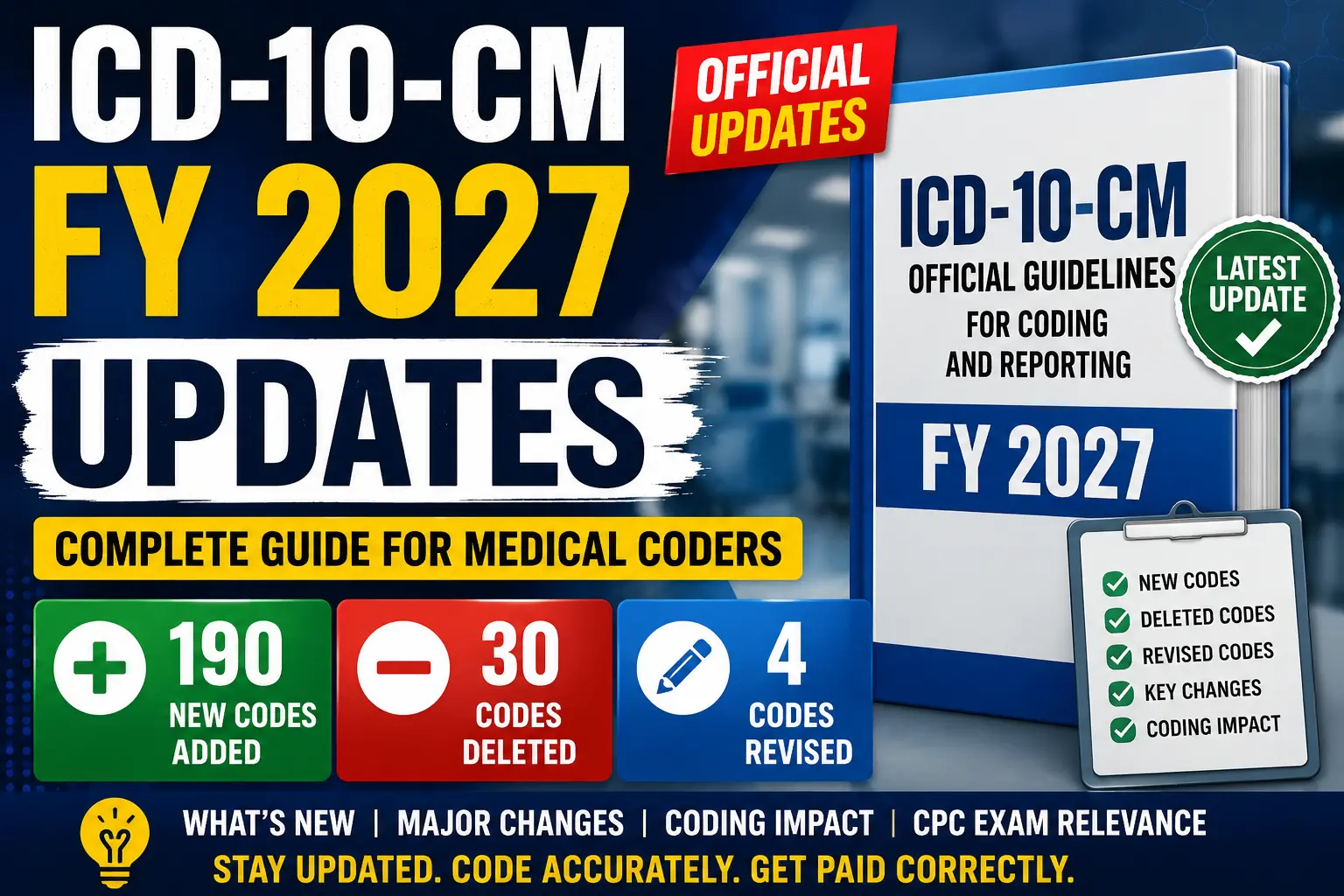
ICD-10-CM FY 2027 at a Glance
| Update | Total |
|---|---|
| New Codes Added | 190 |
| Codes Deleted | 30 |
| Revised Codes | 4 |
The FY 2027 update focuses on increasing coding specificity across multiple specialties, including oncology, cardiology, endocrinology, ENT, obstetrics, orthopedics, genetics, toxicology, and preventive medicine.
Major Highlights of the FY 2027 Update
1. Expansion of Cancer Coding
Several new diagnosis codes have been added for secondary malignant neoplasms to improve documentation accuracy.
Examples include:
- Secondary malignant neoplasm of the larynx
- Secondary malignant neoplasm of the pharynx
- Secondary malignant neoplasm of the oral cavity
These additions provide greater specificity for oncology coding and cancer registry reporting.
2. New Cardiology Diagnosis Codes
The cardiovascular chapter received several important updates.
Examples include:
- Familial-genetic dilated cardiomyopathy
- Arrhythmogenic cardiomyopathy
- Brugada syndrome
- Ventricular bigeminy
- Catecholaminergic polymorphic ventricular tachycardia (CPVT)
Several older, less-specific cardiomyopathy and arrhythmia codes have also been replaced with more detailed options.
3. Endocrine and Metabolic Updates
New diagnosis codes now identify:
- Post-bariatric hypoglycemia
- Other postprocedural hypoglycemia
These additions help improve documentation for patients experiencing metabolic complications following bariatric or other surgical procedures.
4. ENT Coding Improvements
FY 2027 introduces dedicated diagnosis codes for odontogenic sinusitis affecting different sinus locations, including:
- Maxillary sinus
- Ethmoid sinus
- Frontal sinus
- Sphenoid sinus
- Unspecified sinus
These changes allow ENT specialists and coders to capture more precise clinical information.
5. Orthopedic and Musculoskeletal Changes
Important orthopedic updates include:
- New laterality-specific codes for plantar fasciitis
- More detailed plantar fascial fibromatosis codes
- Expanded osteomyelitis codes by anatomical site and laterality
These changes improve coding specificity and clinical reporting.
6. Obstetric Coding Expansion
One of the largest areas of growth involves obstetric diagnosis coding.
New codes now cover conditions such as:
- Interstitial ectopic pregnancy
- Cesarean scar ectopic pregnancy
- Cervical ectopic pregnancy
- Cornual ectopic pregnancy
- Continuing pregnancy after vanishing twin syndrome
These additions provide much greater clinical detail for maternal healthcare documentation.
7. Genetics and Rare Diseases
FY 2027 also introduces new diagnosis codes for several inherited and rare conditions, including:
- Loeys-Dietz syndrome
- Lynch syndrome
- BRCA1-related familial cancer syndrome
- BRCA2-related familial cancer syndrome
- Li-Fraumeni syndrome
These additions support improved reporting for hereditary disease management.
8. New Exposure History Codes
Several new Z codes have been introduced for documenting exposure history, including:
- Agent Orange exposure
- Burn pit exposure
- Blast overpressure exposure
- Gadolinium exposure
These updates are particularly important for veteran healthcare documentation and occupational medicine.
Deleted ICD-10-CM Codes
The FY 2027 release also deletes several outdated diagnosis codes. In many cases, these codes have been replaced with more specific alternatives rather than being removed without replacement.
Examples include deleted codes related to:
- Dilated cardiomyopathy
- Other cardiomyopathies
- Certain arrhythmias
- BMI classification
- Plantar fascial fibromatosis
- Osteomyelitis site categories
Medical coders should review deleted codes carefully to avoid claim rejections.
Revised Code Descriptions
Four existing code descriptions have been revised to improve clarity and coding accuracy. These revisions help ensure documentation better reflects current clinical terminology.
Why These Updates Matter
The FY 2027 ICD-10-CM changes are designed to:
- Improve diagnostic specificity
- Support accurate reimbursement
- Enhance public health reporting
- Reduce coding ambiguity
- Align coding with current medical practice
For healthcare organizations, adopting these updates promptly can help minimize coding errors and claim denials.
Tips for Medical Coders
To prepare for FY 2027:
- Download the official ICD-10-CM files from CMS/NCHS.
- Review all new, deleted, and revised codes relevant to your specialty.
- Update coding software and EHR systems.
- Attend ICD-10-CM update training sessions.
- Share coding changes with providers to improve documentation.
Frequently Asked Questions (FAQs)
1. How many new ICD-10-CM codes were added in FY 2027?
A total of 190 new diagnosis codes were introduced.
2. How many codes were deleted?
30 ICD-10-CM codes were removed or replaced with more specific options.
3. How many code descriptions were revised?
Four code descriptions were revised in the FY 2027 update.
4. Who should review these updates?
Medical coders, billers, physicians, clinical documentation specialists, healthcare administrators, and CPC exam candidates should review the FY 2027 changes.
5. Where can I download the official FY 2027 ICD-10-CM update?
The official files are available from the Centers for Medicare & Medicaid Services (CMS) and the National Center for Health Statistics (NCHS).
Conclusion
The ICD-10-CM FY 2027 update introduces meaningful improvements across multiple specialties by adding 190 new codes, deleting 30 outdated codes, and revising 4 existing code descriptions. These changes enhance coding accuracy, support better clinical documentation, and align the classification system with modern healthcare practices.
Whether you’re a medical coder, healthcare provider, medical billing professional, or CPC student, reviewing these updates before implementation is essential. Staying current with annual ICD-10-CM revisions helps ensure coding compliance, accurate reimbursement, and high-quality patient data.
References
- Centers for Medicare & Medicaid Services (CMS)
- National Center for Health Statistics (NCHS)
- Official ICD-10-CM FY 2027 Addenda and Code Files
Share this article For More Information.
If you have any questions, please contact us.
Thanks For Reading this Article.
ICD 10 CM New updates 2027 Chapter Wise
ICD 10 CM New updates 2027
ICD Guidelines :-https://medicopediaa.com/category/icd-guidlines/
For Any Query : DM me on Insta : – @medico_pediaa