CPT Modifier 24 Explained with Examples Complete Guide for Medical Coders
Welcome To Medico Pediaa :- Modifier 24 is one of the most important modifiers used during the postoperative period. Many medical coders confuse when it should be reported, leading to claim denials or incorrect reimbursement.
If you’re preparing for the AAPC CPC exam, working in medical coding, or handling medical billing, understanding Modifier 24 is essential. This guide explains what Modifier 24 means, when to use it, when not to use it, documentation requirements, Medicare considerations, and real-world coding examples.
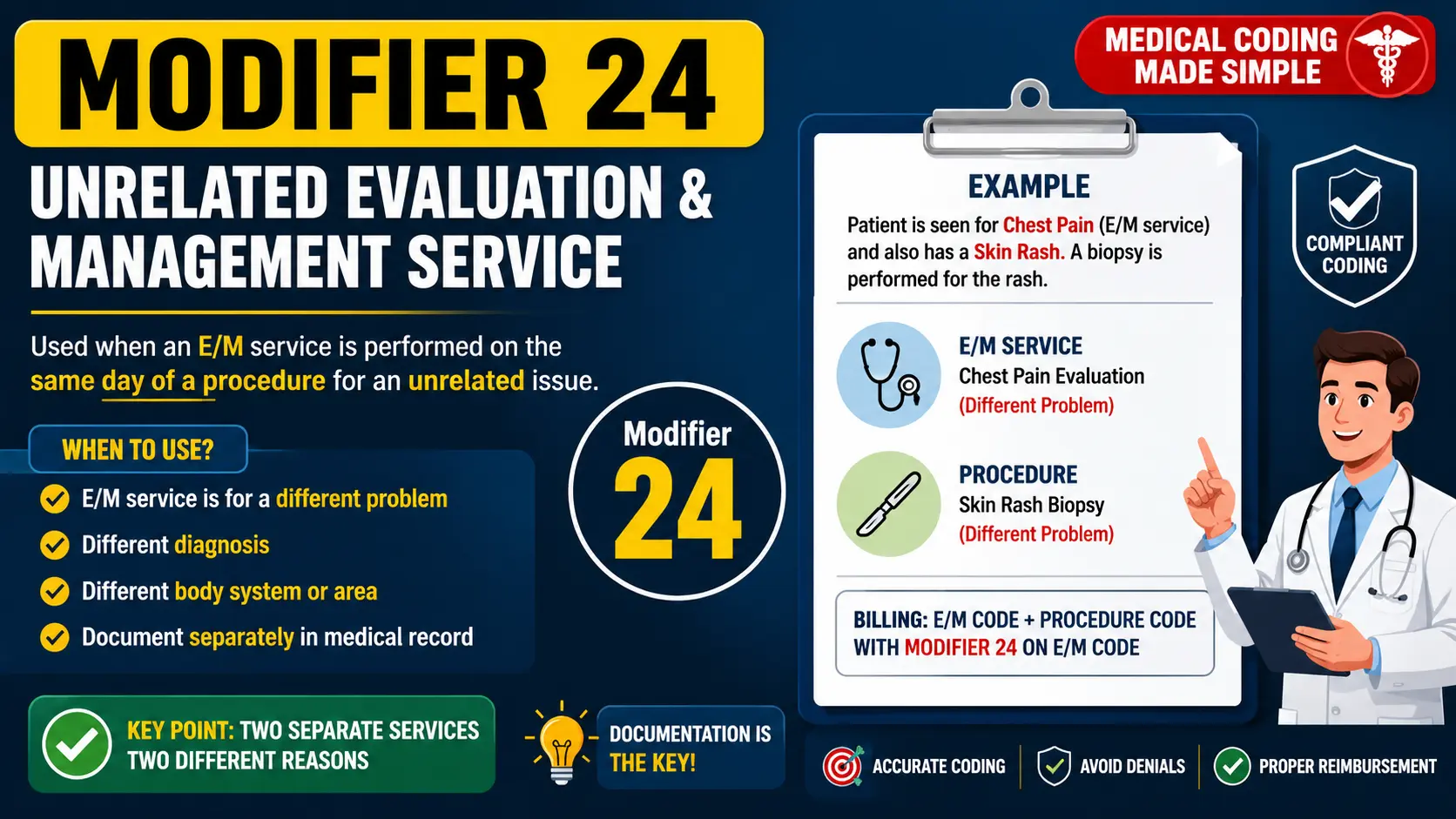
What Is CPT Modifier 24?
According to the CPT® guidelines, Modifier 24 is defined as:
Unrelated Evaluation and Management (E/M) Service by the Same Physician or Other Qualified Health Care Professional During a Postoperative Period.
In simple words, Modifier 24 is used when a physician performs an Evaluation and Management (E/M) service that is completely unrelated to a previous surgery, even though the patient is still within the surgery’s global period.
This modifier tells the insurance payer that the office visit is not related to the postoperative care of the previous procedure and should be considered separately for reimbursement.
Why Is Modifier 24 Important?
During a surgery’s global period, routine follow-up visits are already included in the surgical payment. Therefore, these visits cannot normally be billed separately.
However, if the patient returns with a new or unrelated medical problem, the physician may perform a separately identifiable E/M service. In such cases, Modifier 24 allows the provider to report and receive payment for that unrelated visit.
Proper use of Modifier 24 helps:
- Reduce claim denials
- Ensure accurate reimbursement
- Distinguish unrelated office visits from routine postoperative care
- Maintain compliance with Medicare and payer guidelines
When Should Modifier 24 Be Used?
Modifier 24 should be reported when all of the following conditions are met:
- The patient is still within the global surgical period.
- The physician performs an Evaluation and Management (E/M) service.
- The E/M service is completely unrelated to the surgery.
- Documentation clearly supports that the visit addresses a new or different medical condition.
When Should Modifier 24 NOT Be Used?
Do not use Modifier 24 when:
- The office visit is related to the recent surgery.
- The physician is providing routine postoperative care.
- The visit involves checking the surgical wound or incision.
- The patient is seen for expected postoperative pain or recovery.
- The documentation does not support an unrelated medical condition.
Remember, routine postoperative follow-up is included in the global surgical package and should not be billed separately.
Understanding the Global Surgical Period
The Global Surgical Period is a timeframe during which certain services related to a surgical procedure are included in the payment for that surgery.
Depending on the procedure, the global period may be:
- 0-Day Global Period
- 10-Day Global Period
- 90-Day Global Period
Routine postoperative visits during this period are generally not separately reimbursable.
Modifier 24 applies only when the E/M service is unrelated to the original surgery.
Documentation Requirements
Proper documentation is essential when reporting Modifier 24.
The medical record should clearly include:
- Chief complaint
- History of present illness (HPI)
- Physical examination
- Medical decision making (MDM)
- Diagnosis for the unrelated condition
- Assessment and treatment plan
- Clear documentation showing that the visit is not related to the previous surgery
Strong documentation helps support payment and reduces the risk of denials or audits.
Real-World Coding Examples
Example 1: Correct Use of Modifier 24
A patient undergoes cataract surgery and is in the 90-day global period.
Two weeks later, the patient visits the same physician complaining of acute sinusitis with facial pain and nasal congestion.
The physician evaluates the new illness, performs an examination, and prescribes antibiotics.
Coding Example:
- 99213-24 – Office visit for acute sinusitis
Since the visit is completely unrelated to the cataract surgery, Modifier 24 is appropriate.
Example 2: New Medical Condition During Global Period
A patient has knee arthroscopy.
Three weeks later, while still in the postoperative period, the patient develops urinary tract infection (UTI) symptoms.
The orthopedic surgeon evaluates the new complaint, confirms the diagnosis, and recommends follow-up care.
The office visit addresses a new, unrelated medical condition, making Modifier 24 appropriate when all documentation requirements are met.
Example 3: Chronic Disease Follow-Up
A patient recently underwent hernia repair surgery.
During the global period, the patient returns for scheduled management of hypertension and medication adjustment.
The physician evaluates blood pressure, reviews medications, and updates the treatment plan.
Because hypertension management is unrelated to the surgical recovery, Modifier 24 may be reported on the E/M service.
Incorrect Example
A patient returns after shoulder surgery for:
- Suture removal
- Wound inspection
- Pain assessment related to the surgery
- Routine healing evaluation
These services are part of normal postoperative care.
Modifier 24 should NOT be reported.
Medicare Considerations
Medicare recognizes Modifier 24 when it is used correctly.
Healthcare providers should ensure:
- The E/M service is unrelated to the surgical procedure.
- Documentation clearly supports the separate medical condition.
- The modifier is appended to the E/M code, not the surgical procedure.
Routine postoperative visits remain part of the global surgical package and are not separately payable.
CPT Modifier 24 Explained with Examples
Common Mistakes in Modifier 24
Medical coders often make these errors:
- Using Modifier 24 for routine postoperative follow-up visits.
- Reporting Modifier 24 without supporting documentation.
- Applying Modifier 24 to procedure codes instead of E/M codes.
- Confusing Modifier 24 with Modifier 25 or Modifier 57.
- Failing to document that the condition is unrelated to the surgery.
Avoiding these mistakes helps improve claim accuracy and compliance.
Modifier 24 vs Modifier 25
These two modifiers are commonly confused.
| Modifier 24 | Modifier 25 |
|---|---|
| Used during a postoperative global period | Used on the same day as a procedure |
| Indicates an unrelated E/M service | Indicates a significant, separately identifiable E/M service |
| Requires an existing global period | Does not require a global period |
| Applied to the E/M code | Applied to the E/M code |
Knowing the difference is important for both real-world coding and the CPC certification exam.
CPC Exam Tips
If you’re studying for the CPC exam, remember:
- Modifier 24 applies only to E/M services.
- It is used during the global surgical period.
- The visit must be unrelated to the surgery.
- Routine postoperative care is never reported with Modifier 24.
- Documentation determines whether the modifier is appropriate.
Quick Reference Table
| Scenario | Modifier 24 Needed? |
|---|---|
| New illness during global period | ✅ Yes |
| Hypertension follow-up unrelated to surgery | ✅ Yes |
| Routine wound check | ❌ No |
| Suture removal | ❌ No |
| Postoperative pain evaluation related to surgery | ❌ No |
Frequently Asked Questions (FAQs)
1. What is Modifier 24 used for?
Modifier 24 identifies an unrelated Evaluation and Management (E/M) service performed during the postoperative global period.
2. Can Modifier 24 be used on procedure codes?
No. Modifier 24 is reported only with Evaluation and Management (E/M) codes.
3. Does Medicare recognize Modifier 24?
Yes. Medicare accepts Modifier 24 when documentation supports that the E/M service is unrelated to the original surgery.
4. Can Modifier 24 be used for postoperative wound checks?
No. Routine postoperative care, including wound checks and suture removal, is included in the global surgical package.
5. What documentation is required?
The medical record should clearly demonstrate that the patient’s condition is unrelated to the surgery and that a medically necessary E/M service was provided.
Conclusion
Modifier 24 is an essential modifier for reporting unrelated Evaluation and Management services during a postoperative global period. Correct use requires a clear understanding of the global surgical package, thorough documentation, and careful distinction between routine postoperative care and unrelated medical conditions. By following CPT and Medicare guidelines, medical coders and healthcare providers can reduce claim denials, improve reimbursement accuracy, and maintain coding compliance.
References
- American Medical Association (AMA). CPT® Professional.
- Centers for Medicare & Medicaid Services (CMS). Medicare Claims Processing Manual.
- Medicare Learning Network (MLN). Global Surgery and Evaluation & Management Resources.
CPT Modifier 22 Explained :- https://medicopediaa.com/cpt-modifier-22-explained-with-examples/
CPT Modifier 23 Explained :-https://medicopediaa.com/cpt-modifier-23-explained-with-examples/
Share this article For More Information.
If you have any questions, please contact us.
CPT Modifier 24 Explained with Examples Complete Guide for Medical CodersMedical Coders
Thanks For Reading this Article.
DM me on Insta : – @medico_pediaa